
The Future of Humanity and AI 2026: From Oxford to Versailles
This August, academics and students from the University of Oxford and Tsinghua University came together for the second Annual Workshop on Future Humanities and AI - an interdisciplinary forum exploring the intellectual and societal questions emerging in an age of rapid technological change.
Bringing together perspectives from the humanities, social sciences, philosophy, medicine, law and technology, the forum began at Oxford before continuing to the Palace of Versailles. Across five days of keynote lectures, talks, peer review and cultural exchange, participants were encouraged not only to share ideas, but to build conversations from which future international collaboration can grow.
The Oxford lectures set the tone. Professor Bernie Hogan (Oxford Internet Institute) explored deepfakes, representation and authenticity in Frustrating the Proper Likeness, while Dr Peter Conroy (Tsinghua) brought a humanities lens to culture and politics in Hyperculture. Together they reflected a central principle of the forum: that understanding AI requires more than technological expertise alone.
At Versailles, participants were welcomed by the host Pierre-Emmanuel Lecerf, President of the Public Establishment of the Palace of Versailles, Laurent Brunner, Director of its Royal Opera and Professor Ying Xia, Dean of Rixin College, Tsinghua University. Against this historic backdrop, three further keynotes approached technology and humanity from philosophy, economics and ethics: Professor Asher Yun-Peng Jiang(Tsinghua) on Frege and the philosophy of language; Dr Renaud Foucart (Lancaster) on the socio-economic challenges facing modern societies; and Dr Mackenzie Graham (Ethox Centre, Oxford) on AI and the Future of Trust.
Student research at the heart of the forum
Alongside the keynotes, students from both universities presented their own research papers and took part in structured peer review. Their subjects ranged from privacy and open justice to language, warfare, political bias, collective memory and even the possibility of robot pain — demonstrating how questions once considered purely technological are now being examined through law, philosophy, linguistics, medicine and the social sciences. One participant described the forum as an "exceptionally valuable and inspiring experience."
Looking ahead
In his closing remarks, Dr Shidong Wang, the co-organizer and Director of the Oxford Prospects and Global Development Institute, reflected on the longstanding collaboration on this workshop and the value of meaningful academic exchange:
"Why travel? Because there is something that can't be transmitted through a screen - a sharing of culture through meals, conversations and sometimes disagreements. Together, we can answer these questions better than any of us could alone."
From Oxford to Versailles, The Future of Humanity and AI 2026 showed the value of creating spaces where scholars can approach shared global questions from genuinely different perspectives.
This year's 9 Oxford presenters were selected from more than 50 applications, reflecting the strength of interest in the programme. Their papers will be reviewed and published by Springer as part of an edited volume, The Future of Humanity and AI.
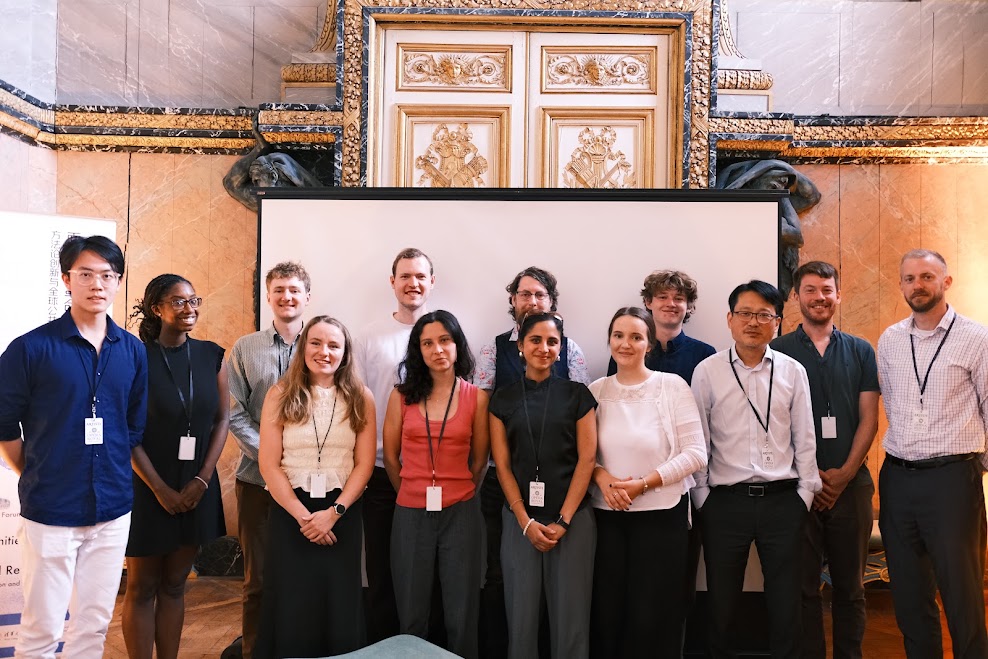
• Max Davy, DPhil Social Data Science – Silent Gatekeepers: LLM Political Bias in Information Processing Tasks
• Riley Harris, DPhil Philosophy – Detecting Robot Pain: Adapting Animal Frameworks to Emerging Systems
• Ines Trichard, MSc Social Data Science – Privacy in Open Justice: Evaluating De-Identification Methods for UK Employment Tribunal Decisions
• Ximena Verastegui, MPhil Linguistics – After Babel: Language Models and the Homogenisation of Human Language
• Jake McMeekin, MMathPhil Philosophy – Can Just War Theory Coherently Classify Deployers and Programmers of AI-Powered Drones?
• Skylar Hughes, MSc Social Science of the Internet – ‘The AI Told Me I Was Right!’: Sycophantic AI, Metacognitive Corruption and the Paradox of Disclosure
• Kateryna Fadieieva, MPhil International Relations – Algorithmic Memory: AI, Digital Culture and the Construction of Collective Futures
• Maximilian Pralle, DPhil Law – Governing AI-Platform Hybrid Risks: Methodological Challenges and the Need for Interdisciplinarity
• Julian Shellard, BA Medicine – The Rising Tide: Governing AI Scientists to Protect the Island of Knowledge
The Future of Humanity and AI 2026 • Oxford Prospects and Global Development Institute